Technology with purpose
Building systems for the world’s most essential environments.
Integrated Sensing & Control
Many complex systems – whether a structure, environmental site, growing system or bioprocess – cannot be understood from a single measurement in isolation.
Terabithia develops integrated systems that combine physical sensing, embedded electronics, communications, data analysis and control.
We design these technologies as modular building blocks that can be adapted to different operating environments and measurement challenges.
Features

ENVIRONMENTAL & DISTRIBUTED MONITORING
Terabithia develops distributed sensing platforms for environments where conditions vary across location and time, communication may be constrained, and multiple measurements need to be interpreted together.
Systems can combine local sensing, edge processing, resilient communications, remote visualisation and condition-based alerts for field and infrastructure applications.
Custom Sensing & Instrumentation
We develop and deploy highly specialised sensors tailored to the unique demands of your environment.
We develop and integrate specialised sensing and instrumentation around application-specific measurement requirements, including situations where conventional off-the-shelf approaches are unsuitable or incomplete.
Modelling, Inference & Intelligent Analysis
Multi-sensor analysis, time-series modelling, computer vision, anomaly detection, optimisation and heuristic or machine-learning methods are used where they provide useful information beyond direct measurement.
Monitoring & Operator Interfaces
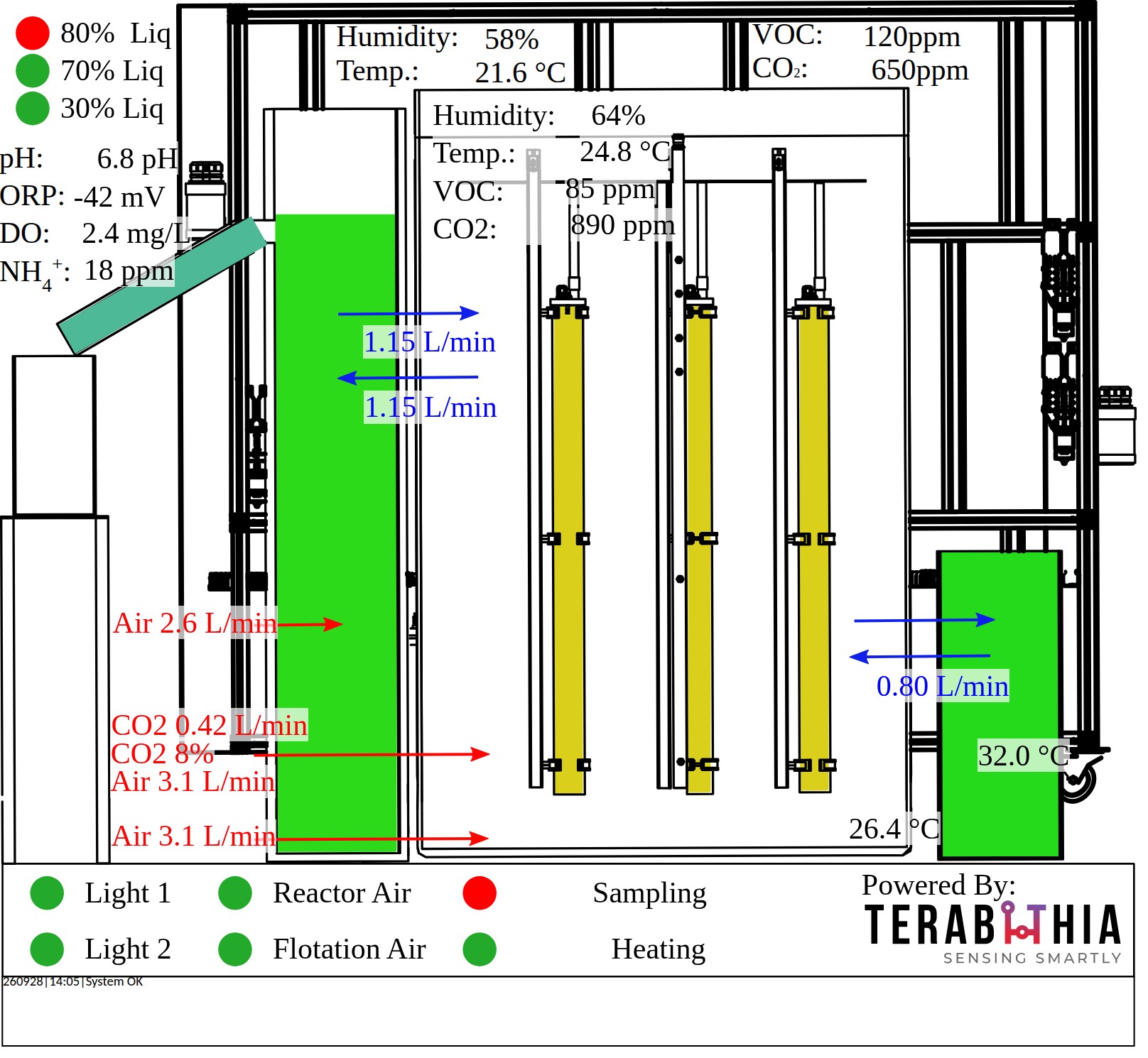
Our interfaces combine real-time visualisation, logging, alerts and system control, giving operators a clear view of current conditions and system behaviour.

What integrated sensing enables
By combining measurement, data interpretation and physical-system integration, Terabithia develops platforms that can support:
- Condition awareness: Understanding how systems change over time rather than relying on isolated measurements.
- Anomaly and trend detection: Identifying deviations, gradual change and emerging problems from multi-sensor data.
- Resource and process optimisation: Using measured state to improve how equipment, inputs and processes are operated.
- Automated response: Linking sensing and analysis to alerts, operator decisions or closed-loop control.
- Transferable engineering: Adapting common sensing, communications and analysis architectures to different deployment environments.
Our Technology Stack
Terabithia develops integrated sensing systems across the complete measurement chain – from physical acquisition and embedded processing to connected data infrastructure, analysis and automated response. Our modular technology stack allows these capabilities to be adapted to different sensing modalities, operating environments and application requirements.

Sensing & Instrumentation
Physical measurement, sensor integration and multi-parameter acquisition. Powered by our own OSMOPOP technology.

Embedded Systems
Electronics, firmware and edge processing

Monitoring & Interfaces
Data logging, visualisation, HMI and alerts

Connected Sensor Networks
Wired/wireless, mesh and remote deployment

Automation & Control
Closed-loop interaction with the physical system

Data & Intelligent Analysis
Time-series analysis, sensor fusion, vision, inference and optimisation
WHAT MAKES US DIFFERENT
Our R&D combines expertise across sensing, materials, electronics, instrumentation, software and physical-system integration.
- Full-Stack Sensing Engineering
From sensor interface and electronics through firmware, communications, data and control. - Multi-Disciplinary R&D
Combining physical measurement, engineering, modelling and experimental validation rather than treating hardware and software separately. - Adaptable Platform Architecture
Core technologies designed to transfer between different measurements, operating environments and application domains. - Prototype to Field System
Capability to develop, integrate and test systems across laboratory, pilot and real-world environments. - UK-Based Engineering & Assembly
System design, integration, prototyping and assembly are undertaken in the UK, with external specialist manufacturing used where appropriate. - Multi-disciplinary Engineering Team
Terabithia brings together expertise across sensing, embedded systems, materials, controls, software, biotechnology and applied R&D. Our team combines in-house engineering capability with specialist academic and industrial collaboration to develop and validate systems from prototype through to field deployment

CONTROLLED IRRIGATION & FERTIGATION
Terabithia integrates sensing, automation and control to optimise the delivery of water and nutrients according to actual system conditions rather than fixed schedules.
For irrigated maize, published studies indicate that controlled irrigation and fertigation strategies can reduce water use by approximately 15–25% and fertiliser inputs by 10–25%, while improving resource-use efficiency and maintaining productive yields.
Potential impact:
- 15–25% lower water use
- 10–25% lower fertiliser input
- 20–35% higher water-use efficiency
Indicative values based on published benchmarks. Actual performance depends on crop, climate, soil conditions and baseline practice.
CONTROLLED ENVIRONMENT AGRICULTURE
Closed-loop monitoring and automated control can reduce unnecessary water replacement and nutrient losses while maintaining more stable growing conditions.
For recirculating and vertical growing systems, tighter control of irrigation, dosing and environmental conditions can provide further incremental efficiency gains over conventional control approaches.
Illustrative engineering targets
- 5–20% lower fresh-water make-up
- 5–15% lower nutrient consumption
- 10–30% lower drain and bleed losses
Illustrative targets rather than guaranteed Terabithia performance.
Dynamic Lighting Regimes
Artificial lighting is one of the largest energy demands in controlled-environment agriculture. Published studies report that lighting can account for around 60–85% of electricity use in vertical farms and approximately 20–30% of total production costs, depending on crop, facility design and climate-control requirements. [1]
By tailoring light delivery to crop requirements and reducing unnecessary optical output, substantial reductions in lighting energy are possible. Published experimental work has demonstrated reductions of up to 50% in lighting energy per unit biomass compared with less targeted LED configurations, while dynamic lighting-control studies have reported reductions of at least 43% in lighting electricity relative to fixed-hour operation. [2]
Potential engineering impact:
- 20–40% lower lighting electricity demand as a practical optimisation target
- Up to ~50% lower lighting energy per unit biomass demonstrated in published experimental studies
- 60–85% of vertical-farm electricity consumption can be associated with lighting
- ~20–30% of total production cost can therefore be directly influenced by lighting strategy
For context, recent vertical-farm studies report total electricity use of roughly 800–1,125 kWh/m²/year, equivalent to around 2.2–3.1 kWh/m²/day. At a 60–85% lighting share, approximately 1.3–2.6 kWh/m²/day may therefore be consumed by lighting alone. [3]
Indicative values based on published controlled-environment and vertical-farming studies. Actual savings depend on crop requirements, existing lighting technology, photoperiod, facility design and baseline operation.
[1] 10.3389/fsci.2024.1411259
[2] 10.1016/j.lssr.2014.06.002
[3] 10.1016/j.apenergy.2024.124669
Adaptive Process Control
Biological processes can require substantial operator time for routine observation, sampling, recording, dosing and adjustment. Terabithia integrates continuous sensing with automated dosing, gas delivery, environmental control and process monitoring so that routine interventions can be performed automatically while operators retain oversight of the process.
In a representative manually supervised R&D or pilot process requiring approximately 3–4 hours of operator attention per day, automation of routine monitoring, logging and corrective actions could reduce direct operator involvement to approximately 0.5–1.5 hours per day, depending on sampling and process requirements.
Illustrative operational impact:
- ~50–80% reduction in routine operator time
- 4 h/day → ~1 h/day represents a 75% reduction in hands-on supervision
- 24/7 process monitoring without continuous operator presence
- Automated control of routine dosing, gas delivery and other corrective actions
- Reduced dependence on manual observations and repetitive data recording
Published bioprocess studies support the use of automated pH, dissolved-oxygen, feeding and monitoring systems to reduce manual intervention, although labour savings vary substantially by process. [1]
Operator-time figures are illustrative engineering scenarios rather than guaranteed Terabithia performance. Actual savings depend on process complexity, sampling requirements, existing automation and operating procedures.
[1] 10.1007/s13593-025-01055-w
PARTNERS