innovation
OSMOPOP: One-Sensor–Multiple-Output Sensing with Integrated Intelligence
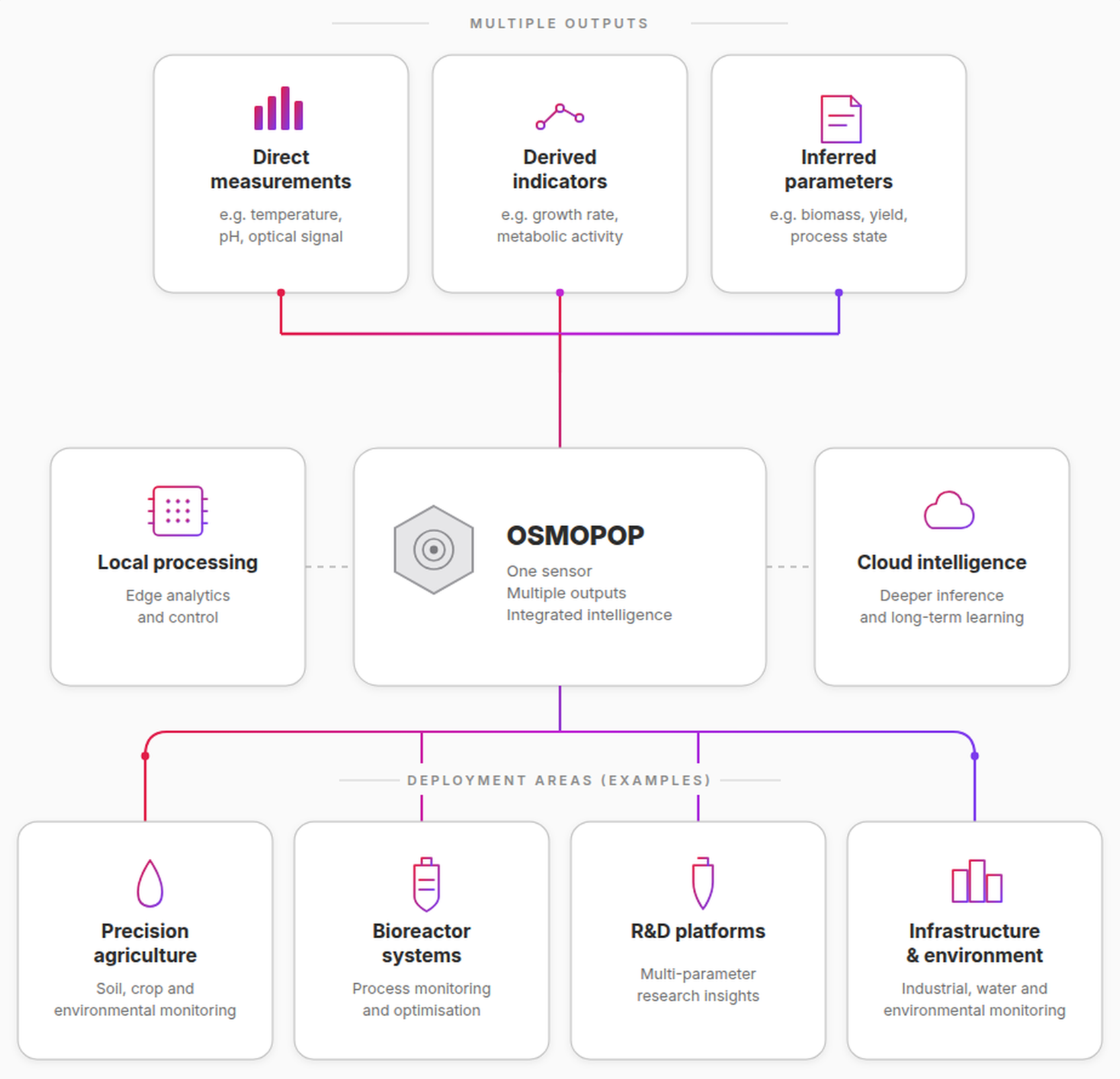
At the core of our innovation is OSMOPOP, Terabithia’s proprietary sensing architecture based on the principle of one-sensor–multiple-output design.
Depending on the sensing modality, outputs may include directly measured signals, derived indicators or inferred parameters generated from the sensor response. This approach enables each OSMOPOP unit to extract multiple parameters from a single sensor, significantly reducing system complexity while delivering rich, high-value data.
OSMOPOP systems are engineered to monitor key indicators. For more specialised applications, OSMOPOP can be modularly extended to provide additional readouts, forming a unified, intelligent network that adapts to specific deployment needs.
With its hybrid edge–cloud architecture, OSMOPOP processes core insights locally for responsiveness, while deeper inference and long-term learning are handled on the server side. This allows the system to evolve over time, continuously refining outputs through heuristic learning and real-world feedback.
Its mesh-enabled communication supports reliable deployment in low-connectivity environments, and its graphical, language-flexible user interface ensures usability across diverse contexts.
The architecture is application agnostic and can be configured around different sensing modalities and deployment requirements, from distributed environmental monitoring to industrial, infrastructure and biological systems.
INTELLIGENT CONTROL & OPTIMISATION
Terabithia is developing adaptive sensing and control approaches for complex real-world systems.
Our work combines data-driven modelling, optimisation, machine vision and multi-sensor analysis to improve monitoring, interpretation and control. These methods are designed to operate alongside physical sensing and automation platforms rather than as isolated software tools.
Current development focuses on improving robustness, adaptability and decision-making under changing real-world conditions, including situations where measurements may be indirect, noisy or incomplete.
This work remains an active area of R&D, with new methods evaluated through iterative testing, validation and integration with Terabithia’s wider sensing and control technologies.
The objective is to enable systems that can respond more intelligently to changing conditions, make better use of available data and support more effective automated control.

Custom Lighting Research & Integration
We’ve conducted extensive R&D into how variations in spectrum, timing, and intensity affect biological systems. This knowledge informs our design of tuneable lighting systems integrated into bioreactors, vertical farming, and R&D platforms.
Our lighting platforms are modular, feedback-responsive, and highly efficient—enabling control of photonic environments that adapt dynamically to biological goals.

Diagnostic Sensing & Adaptive Response
Agricultural application: Terabithia Agro-Theranostics
Our system combines real-time diagnostics with automated responses using sensor networks and AI. We support:
- Carbon-negative growth systems
- Closed-loop agriculture
- Yield forecasting
- Adaptive environment control
Combined Approaches for Development and Deployment of Chemical-Free Fertiliser Practices
We integrate adaptive delivery technologies with our sensing platforms to create efficient, low-input agricultural systems. These methods improve uptake, shorten growth cycles, and align with regenerative practices.
Used together with OSMOPOP, they form a feedback loop optimising delivery based on real-time crop conditions

Distributed Environmental Sensing
Terabithia’s sensing architectures are designed for distributed deployment where measurements may vary across location and time, communication may be constrained, and multiple parameters need to be interpreted together.
Current R&D includes methods for improving sensing robustness, local processing, network resilience and interpretation of environmental data across distributed systems.
Emerging Applications
The same core technologies are being extended into new sensing domains, including infrastructure and asset monitoring, where distributed measurements, edge processing and condition-based analysis can provide insight into changing system behaviour.
Partners & Collaborators
Terabithia works with academic, industrial and implementation partners to co-develop, validate and deploy sensing technologies in laboratory, field and commercial environments. Many projects are confidential or governed by NDAs, but our wider ecosystem spans research institutions, technology partners and end-user organisations.
We work with four core groups:
Implementation Partners
Field-testing our solutions in commercial farms and controlled environments.
Research Collaborators
Academic and R&D institutions that help us co-develop and rigorously validate our sensing platforms.
Technology Partners
Integrating our systems with new hardware and intelligent control platforms.
Innovation and FUnding Programmes
Driving shared values
We seek partners who value long-term exchange and meaningful impact. If your organisation is interested in deployment, research, or innovation, connect with us to build sustainable, smart systems together.
PARTNERS